Dallas city leaders receive updates on proposed Houston-Dallas-Ft. Worth high-speed rail project
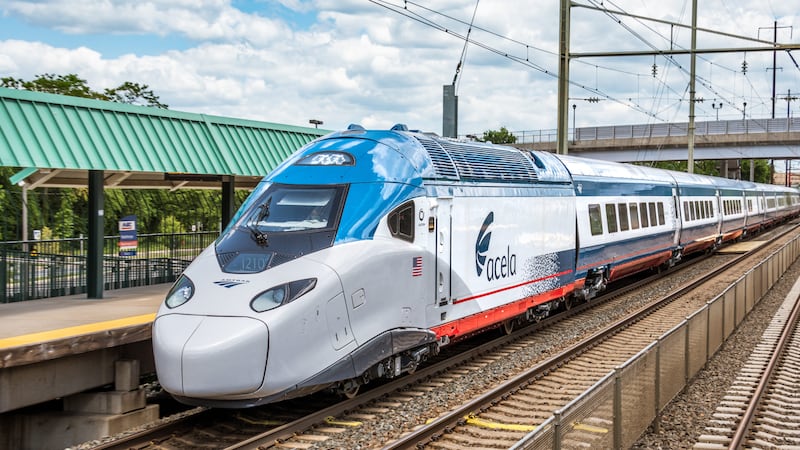
DALLAS, Texas (KBTX) -Amtrak says they’re continuing to explore the path forward as they look to connect the cities of Houston and Dallas, and potentially Fort Worth.
However, there is some skepticism. The railway recently joined the Dallas City staff and the North Central Texas Council of Governments (NCTCOG) for nearly five hours to brief the Dallas City Council on the project.
Council members heard from Andy Byford, Amtrak’s Vice President of High-Speed Rail to learn more about the feasibility of the proposed high-speed train route from Dallas to Houston. When asked if the project was still feasible Byford said yes.
“We were invited in by Texas Central to see if the project is still viable as that’s why we did further market research we believe that it is,” said Byford. “But having a viable project and having the funding and the political assent to proceed with the project are two different things.”
Amtrak’s presentation states that the project fulfills its aim of meeting high travel demand between cities, connecting Amtrak, Dallas’s DART, the Trinity Railroad Express, and Houston’s Metrorail. The cities are also well-spaced to allow for limited stops. However, obtaining a right of way and securing funding are still pending.
Amtrak also highlighted recent successes that make the Dallas-to-Houston route viable. They stated that Amtrak successfully secured federal funding and is actively engaged in the FRA Corridor Identification Program. Additionally, they mentioned ongoing grant applications, running parallel to the development of funding packages, with the potential for financial closure by 2025.
However, some council members remained unconvinced about the Dallas-to-Fort Worth route, pointing to a 2017 FRA study showing a then $12 billion cost with only a 30-second time savings over other options.
“It would cost $12 billion and it would save only 30 seconds as compared to the Trinity Railway Express,” said District 14 Councilmember Paul Ridley. “That to me does not justify the i-30 corridor. It does not justify, in fact, it argues against any high-speed rail as being basically a public works boondoggle.”
Dallas City Council High Speed Rail Presentation by KBTX on Scribd
City leaders are divided on the proposed location near Amtrak’s Union Station, weighing both its advantages and disadvantages. On a positive note, it provides a seamless connection. The federal government approved the station in Cedars back in 2017. However, there are uncertainties regarding its potential impact on a new convention center and a planned 25-acre, multibillion-dollar development centered around the iconic Reunion Tower.
Hunt Realty Investments owns 25 acres near the convention center and has revealed intentions to construct a $5 billion mixed-use development. They told our affiliate CBS Dallas their belief that their plans and the rail line cannot coexist. They argue that a proposed 75-foot-high, elevated high-speed train running through the middle would create an “ugly scar” and jeopardize the proposed development, putting it “at serious risk.”
“For me, there’s some givens on Reunion I find like, like I do about this building that it’s an iconic Dallas building. We’ve heard that it could be threatened with this alignment,” said District 11 Councilwoman Jaynie Schultz.
NCTCOG Transportation Director Michael Morris thought there was a solution, even though it wasn’t ideal.
“If there’s some issue between the Hyatt Regency and looking east to downtown, we simply go on the west side of the Hyatt Regency. But you probably wouldn’t be making all those intermodal connections ‘cause the route is nowhere close to Union Station,” said Morris.
However, Amtrak officials warned the council that alterations to the proposed station location could setback the project and escalate costs.
“With all the permits that we’ve got, the ROD that’s in place, the environmental assessments being done, that, to me, is a massive reopening and will put the entire project at risk,” said Byford.
Despite the challenges, some council members are endorsing the high-speed rail project.
“This is something that, if we are the epicenter of high-speed rail for the entire United States, can take Dallas into a trajectory that I can’t even imagine. We need to look at other countries that have had this technology for decades. We are finally catching up,” said District 6 Councilmember Omar Narvaez.
Looking ahead, a year-long environmental study has started. The group told councilmembers they’re committed to ongoing research on the economic impacts of high-speed rail. They plan to incorporate findings into future City Council briefings and hope to reach a consensus or potential resolutions in support of high-speed rail initiatives soon. High-speed rail operators are expected to go back before the council in a few months.
The complete Dallas City Council Meeting is accessible below, startingat the 30:00 mark.
Copyright 2024 KBTX. All rights reserved.